A Historic Shakeup of the Forest Service
The latest in a calculated attempt to dismantle our nation’s land management agencies
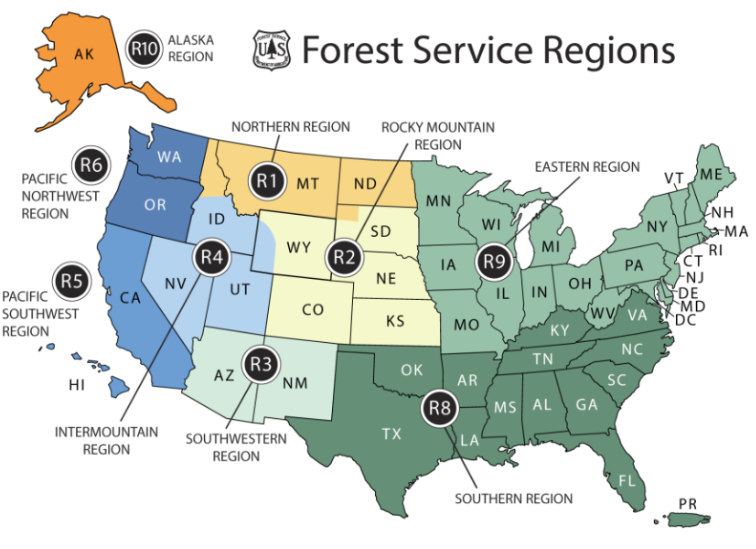
This move raises serious concerns about how, and whether, the Forest Service will be able to effectively steward public lands.
Status Update
Latest action: On March 31, 2026, the U.S. Department of Agriculture’s Forest Service announced it will move its headquarters to Salt Lake City, Utah, and begin a sweeping restructuring of the agency that includes transitioning to a state-based leadership model, building a network of Operations Service Centers, and all but eliminating the agency’s research program. No further comment periods are expected.
Previous updates: On July 24, 2025, USDA Secretary Brooke Rollins announced plans to “reorganize” the USDA. The Departure of Agriculture Reorganization Plan calls for the closure of nine Forest Service Regional Offices and all but a handful of FS Research Stations across the country. A comment period on the proposed reorganization ended on Sep. 30, 2025.
Overview
The U.S. Forest Service recently announced what is arguably the most significant reorganization in its 121-year history. The agency will move its national headquarters from Washington, D.C. to Salt Lake City and shift from its long-standing regional structure to a new state-based model. That means the closure of regional offices, including Region 6 here in Portland, with a new State Director’s office opening in Salem.
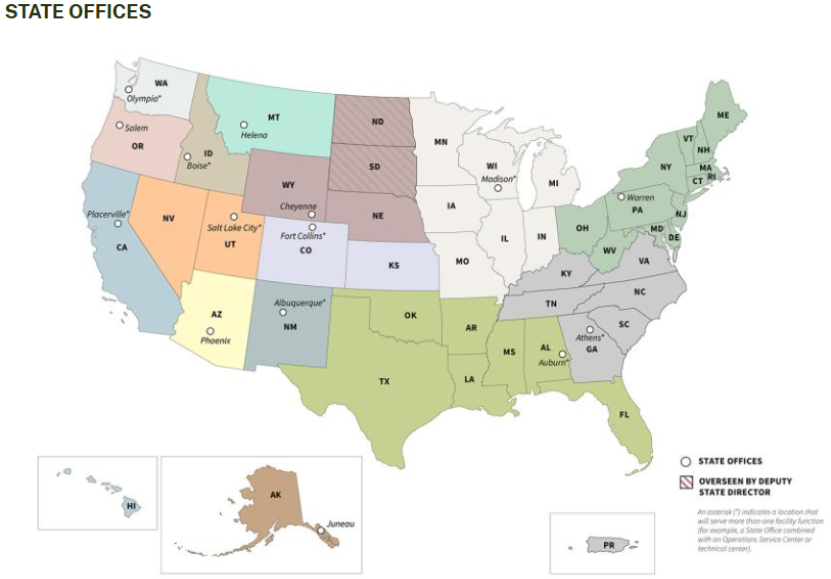
Auburn, AL* – Ozarks/Gulf Coast State Office (Oklahoma, Arkansas, Louisiana, Texas, Mississippi, Alabama, Florida)
Juneau, AK – Alaska State Office (Alaska)
Phoenix, AZ – Arizona State Office (Arizona)
Placerville, CA* – California–Hawaii State Office (California, Hawaii)
Fort Collins, CO* – Colorado–Kansas State Office (Colorado, Kansas)
Athens, GA* – Southern Appalachian State Office (Virginia, North Carolina, Tennessee, Georgia, South Carolina, Kentucky, Puerto Rico)
Boise, ID* – Idaho State Office (Idaho)
Helena, MT – Montana State Office (Montana)
Albuquerque, NM* – New Mexico State Office (New Mexico)
Salem, OR – Oregon State Office (Oregon)
Warren, PA – Mid‑Atlantic/New England State Office (Ohio, West Virginia, Pennsylvania, Maryland, Delaware, New Jersey, New York, Connecticut, Rhode Island, Massachusetts, Vermont, New Hampshire, Maine)
Salt Lake City, UT* – Utah–Nevada State Office (Utah, Nevada)
Olympia, WA – Washington State Office (Washington)
Madison, WI* – Great Lakes/Midwest State Office (Minnesota, Iowa, Wisconsin, Illinois, Michigan, Indiana, Missouri)
Cheyenne, WY – Northern Plains State Office (Wyoming, North Dakota, South Dakota, Nebraska)
An asterisk (*) indicates a location that will serve more than one facility function (for example, a State Office combined with an Operations Service Center or technical center).
Research is also being consolidated, with a new central hub in Fort Collins, Colorado, and many existing research sites slated for closure. While Oregon will retain facilities in Corvallis and La Grande, we still don’t know what this means for the future of the agency’s research, especially as funding cuts loom for programs not aligned with current leadership priorities.
Together, the plan affects ~6,500 employees across the agency’s Washington, D.C., headquarters, 9 regional offices, and 7 seven research stations.
Bark’s Concerns
This reorganization is not just disruptive to the affected employees: it is designed to sideline science, diminish federal capacity for land management, erode the civil service, and push public lands closer to state, and potentially private, control. There are no forced employee reductions, but hundreds will be reassigned to new locations.
These changes are likely to trigger a major loss of institutional knowledge. We’ve seen this before: when the Bureau of Land Management relocated its headquarters in 2020, nearly 90% of affected staff chose to leave rather than move. With thousands of Forest Service positions impacted nationwide, we could see a similar exodus.
All of this is unfolding as we head into what could be a severe wildfire season, compounded by historically low snowpack across the West. At the same time, the Forest Service’s proposed FY27 budget points to deep cuts across nearly every Forest Service program, except those tied to logging and grazing.
Take Action!
Tell lawmakers to stand up for public lands and oppose this disastrous “reorganization” using the form below.
Links
Official Announcement
USDA Fact Sheet
More Specifics + Maps
Action Alert! Comment on the USDA Reorganization
Forest Service Reorganization: The Bigger Picture