Stop the Giveaway of Mt. Hood Public Lands!
At Bark, we believe public lands belong in public hands.
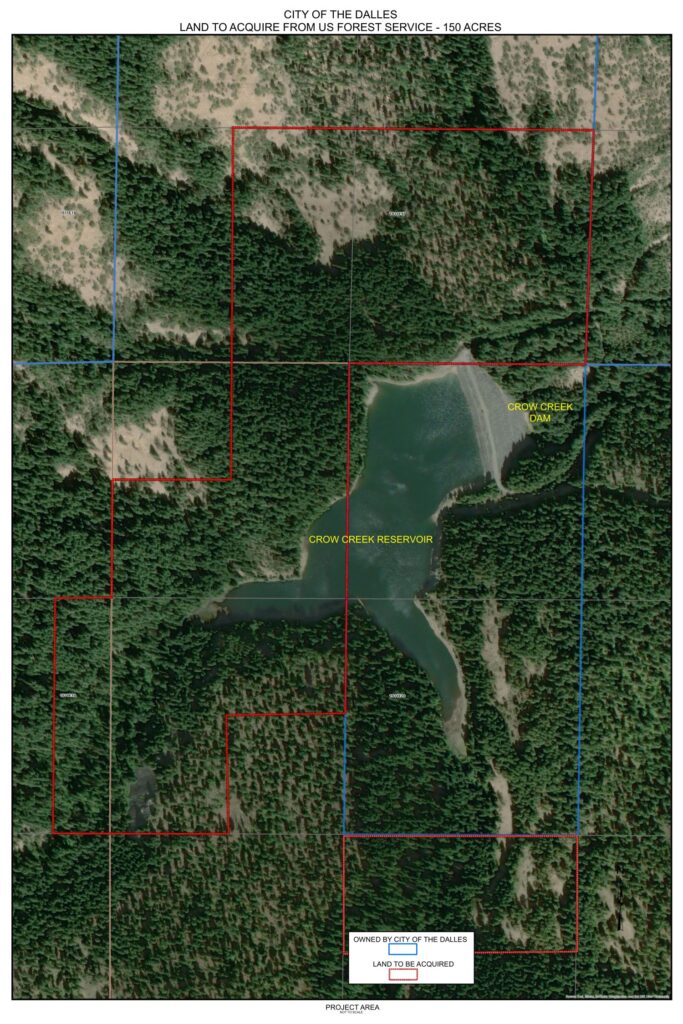
By giving away 150 acres of Mt. Hood National Forest to support water infrastructure for data centers, H.R. 655 sets a dangerous precedent for future development pressures tied to industrial water demand.
Action Alert! Tell Sen. Wyden to vote NO on H.R. 655!
H.R. 655 currently sits in the Senate Committee on Energy and Natural Resources, where Sen. Wyden is a member. The committee had been chaired by Utah Sen. Mike Lee, who has made multiple attempts to sell off public lands since the current administration took office in Jan. 2025.
You can help stop this bill! Use the script provided on our website to call Sen. Wyden at (202) 224-5244 & ask him to oppose this bill!
Wish you could do more? Consider donating to Bark to help us defend and restore Mt Hood National Forest today!
Status Updates
7/15/26 – The bill was granted a hearing in the Senate Subcommittee on Public Lands, Forests, and Mining, which falls under the Senate Energy and Natural Resources Committee.
12/10/2025 – Received in the Senate and Read twice and referred to the Committee on Energy and Natural Resources
Bill Summary
H.R. 655, or The Dalles Watershed Development Act, is a piece of legislation sponsored by Rep. Cliff Bentz (R-OR) that would transfer approximately 150 acres of federal land in Mt. Hood National Forest to the city of The Dalles. This transfer would place the parcels of land surrounding the Crow Creek reservoir under City ownership for municipal purposes.
The city of The Dalles states that transferring these lands is necessary to efficiently manage their watershed and plan for future infrastructure improvements.
Local environmental organizations, including Bark, are concerned that passage of H.R. 655 would allow these lands to be transferred without compensation or public oversight, and could impact the region’s water supply, fish, and wildlife. You can learn more here.
Bark’s Concerns
Since December 2025, Bark has been focused on opposing H.R. 655, a bill introduced by Oregon Rep. Cliff Bentz that seeks to transfer 150 acres of federally held lands in Mt. Hood National Forest to the city of The Dalles, Oregon so that they can expand their water reservoir as Google’s water demands grow.
The Dalles gets 80-85% of its water from watersheds in Mt. Hood National Forest, which are public lands managed by the U.S. Forest Service. If H.R. 655 passes, The Dalles would be able to expand the reservoir without USFS oversight. In addition, this legislation allows these lands to be transferred to the city freely – without compensation to the federal government or public.
Enlarging The Dalles’ reservoir would impact water supply and could be harmful to fish and wildlife. Snowmelt feeds the river and the water reservoir, and when the river has run dry in the past, the downstream Hood and Columbia Rivers received less cold mountain runoff to cool their waters. The result: warm water that makes it hard for aquatic life like coho and Chinook salmon and steelhead to breathe. Warm water can also lead to algal and bacterial blooms, which degrade water quality.
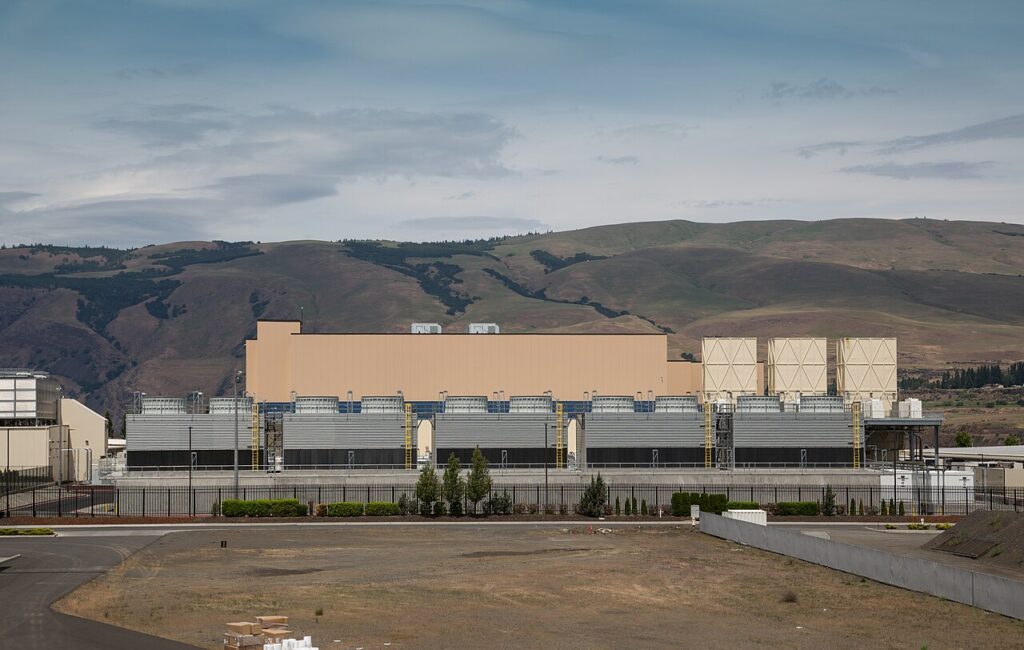
Given the rapid growth of Google’s data centers in the area, the fact that the bill allows for these lands to be transferred freely without compensation to the federal government or the public, and the fact that the transfer would allow the city to raise the reservoir without USFS oversight—potentially sidestepping environmental analyses that would be required on federal lands—we believe this bill sets a dangerous precedent.
Bark staff have been following this bill closely and have met with The Dalles’ Public Works Director, a Wasco County Commissioner, The Dalles City Councilor, the City Manager, local Mt. Hood NF Forest Service staff, staffers in Ron Wyden’s office, and have been interviewed for stories by OPB, SFGate, and Columbia Insight. We have also engaged community members in The Dalles.
A Coalition Forms
In January 2025, Bark helped form a coalition of angling, land-use, and conservation organizations representing tens of thousands of Oregonians to pressure Oregon Senator Ron Wyden to oppose H.R. 655. Together, we drafted and submitted a formal letter to Sen. Wyden voicing our opposition to H.R. 655 and the reasons why we’re concerned about the bill.
You can read the press release on our website and the full text of our letter to Sen. Wyden below.
Why this Matters
| Sets a Dangerous Precedent -Public land giveaway for corporate water projects -Could bypass environmental review | Threatens Our Rivers & Drinking Water -Drains the Dog River Reduces cold water to the Hood & Columbia Rivers |
| Sweetheart Deal for Google -Google uses 40% of The Dalles’ water -$260 Million in tax breaks | Hurts Salmon & Steelhead -Endangers fish populations -Warms critical habitat |
For Bark, this is more than just a story about threats to fish and wildlife, though these are important.
“This is a story about power and influence over water, a human right that is foundational to the well being of all people.”
-Jordan Latter, Bark’s Forest Watch Program Manager
Deep Dive: The Growing Issue of Data Centers’ Water Use
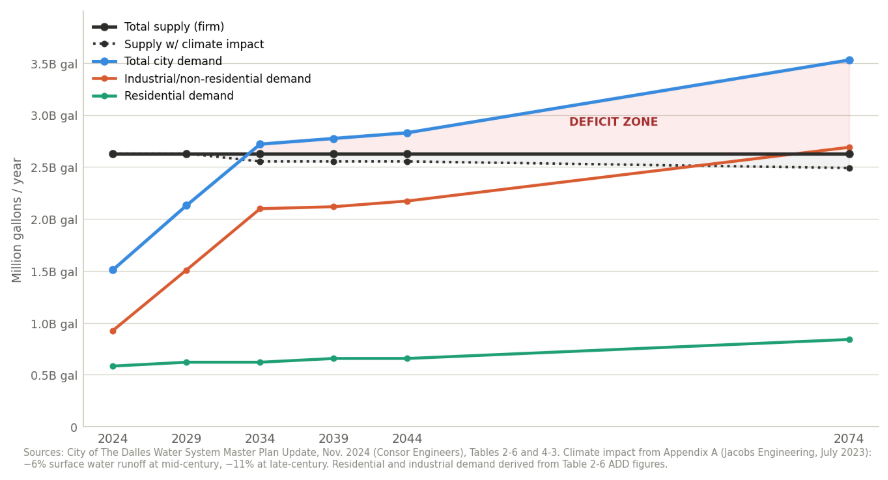
The city of The Dalles faces a projected water supply deficit within its own 10-year planning horizon. Climate change is a real and worsening factor, shifting seasonal runoff earlier and reducing annual watershed yield. But the data from the city’s own master plan tells a clear story: it is industrial demand, overwhelmingly concentrated in the 310/Riverside pressure zone (home to Google’s data centers) that is driving the deficit, necessitating the dam raise, and causing water rates to climb for every resident in The Dalles.
What is driving the deficit?
The city’s firm annual supply capacity is roughly 2,630 million gallons (1,370 MG groundwater + 1,260 MG surface water). That figure is essentially fixed without major new infrastructure. Demand crosses that ceiling around 2034.
Residential demand grows modestly from 584 MG/yr today to 840 MG/yr by 2074, tracking 0.6% annual population growth. Non-residential demand grows from 926 MG/yr today to an estimated 2,690 MG/yr by 2074. Nearly three times the entire current city demand.
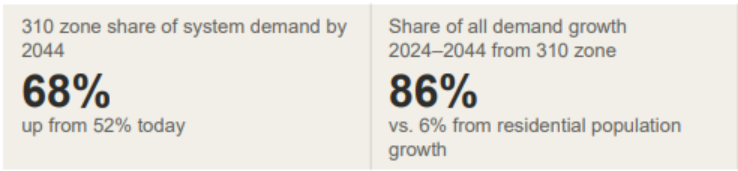
The Water Master Plan breaks down current and projected future water demand by pressure zone. Looking at their own data, water demand is being driven almost entirely by non-residential growth in the 310/Riverside zone.310 not only has the highest current demand, but also shares the largest portion of projected future demand:
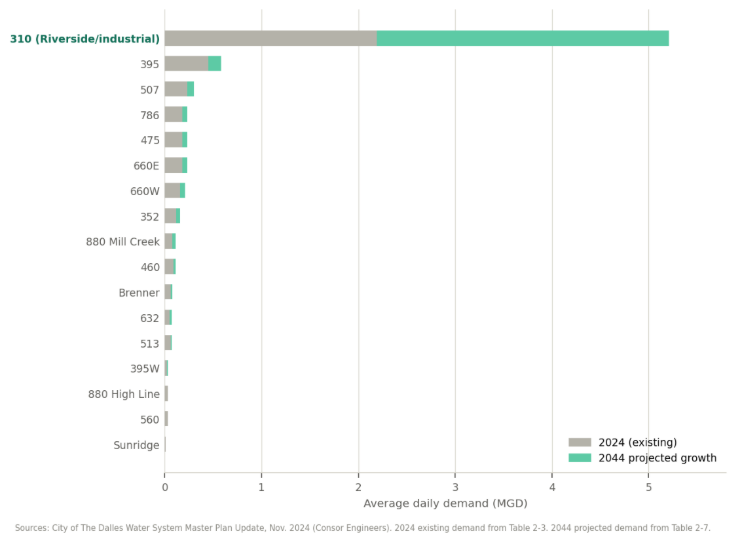
In fact, the Water Master Plan shows that 86% of all projected future water demand will come from zone 310.
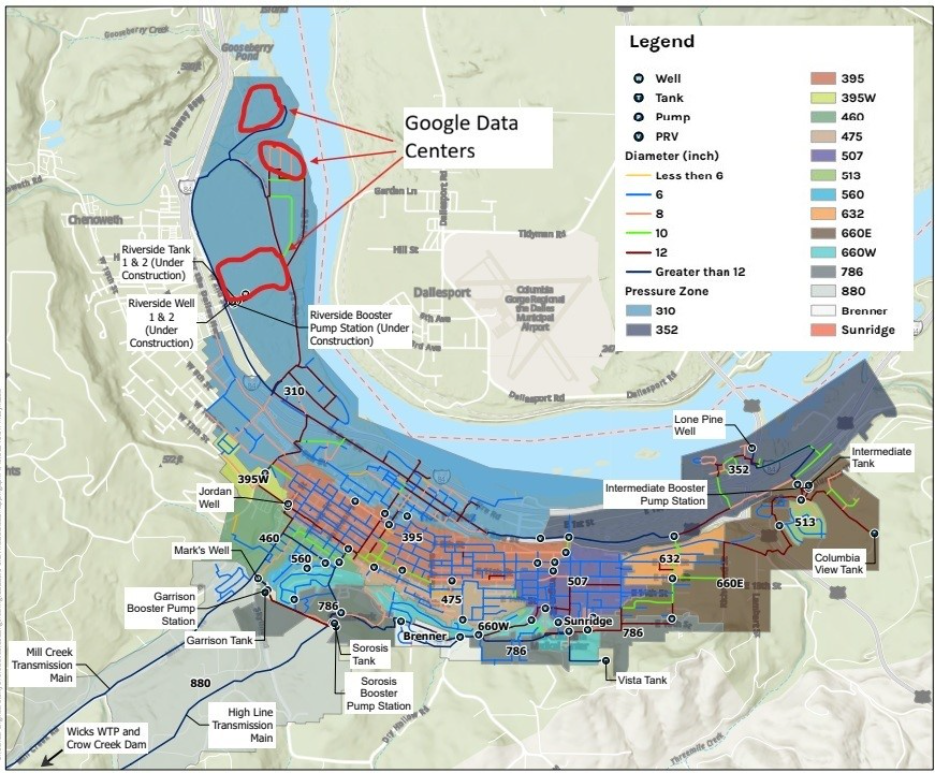
Why does zone 310 matter? As you can see on the map below, that’s where the Google datacenters are located.
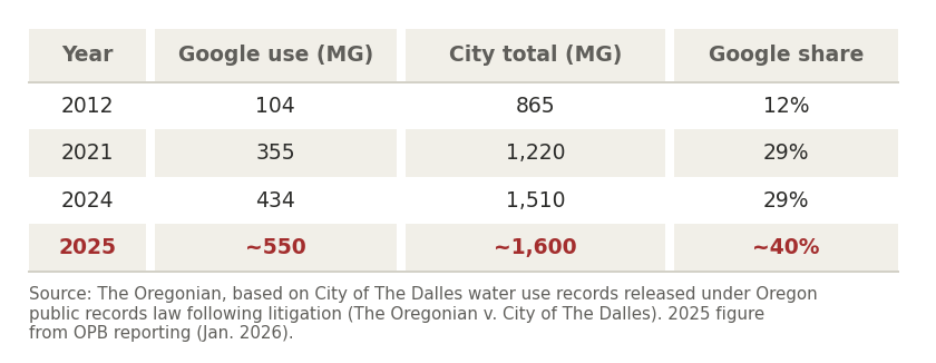
All of this lines up with publicly available information about Google’s water use, obtained by OPB and The Oregonian:
Climate Change
The city has continued to cite climate change and population growth as the main reasons that HR655, and the eventual proposed reservoir expansion, are needed. To be clear, climate change will impact the city’s watershed, just as it will impact many municipal watersheds across the west.
Appendix A of The Master Plan contains a detailed analysis of how climate change will impact the city’s water supply. Under the most extreme climate scenarios, surface water availability is expected to decrease by 6% mid century and 11% late century due to rising temperatures and increasing evapotranspiration (you can see this reflected in the first graph on this page). While this is significant, the most meaningful impact will be a fundamental shift in when water arrives: peak runoff currently occurs in May from snowmelt; by late century it shifts to February from rain events. Less snowpack to act as additional water storage, and earlier runoff well before summer, when the reservoir is already full and before the city’s water demand usually peaks. In the city’s view, this is the primary reason a reservoir expansion is needed. More capacity to store the earlier runoff and a larger buffer between supply and demand.
The earlier runoff timing becomes a crisis primarily because of the collision between when water is available and when it’s needed. That collision has two sides. Climate change is shifting the supply side by moving water availability from summer toward winter. But Google is dramatically widening the demand side, specifically during summer, when data centers run hottest and cooling water use peaks.
Without Google, the city’s average projected demand in 2044 would be roughly 2.5 MGD instead of 7.7 MGD. Essentially flat residential and modest commercial growth. At that demand level, the annual water balance wouldn’t cross into deficit at all within the 20-year planning horizon, even with climate-adjusted supply reductions. The city would still have a meaningful annual surplus through 2044 and well into the 50-year horizon.
The dam raise makes sense specifically in the context of needing to serve peak summer industrial loads that the existing storage simply can’t buffer. Without that load, the storage problem is far less acute. You’d be banking water against a modest residential draw, not against a data center complex that may be consuming 550+ million gallons a year and growing.
Take Action!
Call your Senators and ask them to oppose this bill to protect Mt. Hood and our public lands!
Oregonians: call Senator Wyden at (202) 224-5244.
Not in Oregon? Find the contact information for your senator here.
Script
Hi, my name is [NAME] and I’m a constituent from [CITY, ZIP].
I’m calling to urge [SEN NAME] to oppose H.R. 655, The Dalles Watershed Development Act. The free transfer of our public lands to a city – benefiting a major corporation and degrading our water quality and water supply – should be opposed.
(Pick one or two)
- Please prevent corporations from taking advantage of our rural communities and the finite natural resources they depend on.
- Please help protect the public interest and our public lands and keep these lands as part of the national forest.
- Please help protect our fish and wildlife populations impacted by the lack of a quality water supply.
Thank you for your time and consideration.
IF LEAVING VOICEMAIL: Please leave your full street address to ensure your call is tallied.
Take our Poll!
We also have an active poll where supporters can voice their opposition and express their concerns.
In the News
OPB: “As Google’s water demands grow, The Dalles aims to pull more from Mount Hood forest”
SFGate: “Environmentalists worry Google behind bid to control Oregon town’s water”
Columbia Insight: “Opposition to data centers is growing. How far can it go?”
The Oregonian: “More Oregon water for Google’s data centers, more concern over secrecy”
The Daily Emerald: “Hey, Wyden, stop the steal!”
Associated Files